_edited.png)
What Did a Viking Farm Actually Produce?
When most people hear the word Viking, they imagine ships, warriors, distant voyages, and raiding parties, but most people living in Scandinavia during the Viking Age were not sailing across the sea. They were farming. Their lives revolved around animals, fields, weather, harvests, food stores, and the long preparation required to survive another winter. For many families, the farm was not simply where they lived. It was the center of their whole world.
While Clan Rúnda is Viking inspired rather than a historical reconstruction, that agricultural world is one of the things that continues to inspire what we do here. We do not pretend that our farm is exactly like one that stood in Scandinavia a thousand years ago. We live in a different country, in a different climate, and in a very different world.
While we raise heritage breeds, they are still the modern version of their ancestors, and our farm uses modern tools when they make sense We are not trying to recreate every aspect of Viking Age life. However when we look at the animals we raise, the things we grow, and the traditional skills we practice, there are still meaningful connections to that older way of life.
So what did a Viking age farm actually produce? Quite a lot.
More Than Just Food
A Viking Age farm was expected to provide for much of a household's needs. The animals and fields produced food, of course, but they also provided many of the materials people needed for daily life. Wool became clothing and textiles. Hides became leather. Horn and bone could be shaped into useful objects. Wood from the surrounding landscape became buildings, tools, furniture, containers, and fuel. Everything had a use.
A sheep, for example, was not simply a source of meat. Its wool could be spun into yarn and woven into cloth. The milk would be skyr, cheese, and much more. Its hide could be used after slaughter. The same was true of cattle and other livestock, whose value extended far beyond the food they eventually provided. In this sense, the farm was both a source of food and a workshop. The things people needed were often grown, raised, gathered, made, repaired, or preserved quite close to home.
The Animals of a Viking Age Farm
The exact mix of animals varied from region to region, but archaeological evidence and historical research show that Viking Age farms commonly kept familiar livestock, including cattle, sheep, goats, pigs, and horses. Chickens, geese, and ducks were also part of the agricultural landscape.
Cattle were especially valuable. They could provide milk as well as meat, and milk could be preserved by turning it into butter and cheese. This was particularly important in a world where storing food through the winter required careful planning.
Sheep provided meat, milk, and wool, making them valuable in more than one way. Wool was one of the essential raw materials of everyday life, and spinning and weaving were important household crafts.
Pigs were primarily raised for meat, while horses could serve practical purposes in transportation and agriculture, as well as carrying social and cultural importance.
The animals of the farm were not simply standing in a pasture waiting to become dinner. They were part of an entire system.
Sheep Then and Sheep Now
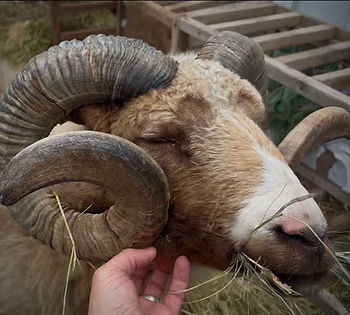
Sheep are one of the places where our own farm feels especially connected to that older Scandinavian world. We raise Icelandic and Gotland sheep, both of which have deep connections to northern Europe and its long tradition of sheep husbandry. That does not mean that we are raising the exact same sheep that would have stood beside a Viking Age longhouse. Modern heritage breeds have histories of their own, and animals change over generations through breeding, selection, and the environments in which they are raised.
Icelandic sheep have roots reaching back to Iceland's settlement period, when sheep were brought to the island by the Norse settlers. They belong to the Northern European short-tailed family of sheep, a group with deep roots across northern Europe.
Modern Gotland sheep likewise have a strong Scandinavian history. They were brought by Vikings from what is modern day Russia and then crossed with the older landrace sheep on the island of Gotland. The modern Gotland breed has now been shaped somewhat by more recent breeding and selection while the older landrace sheep related to that history still survive as the Gute sheep.
For us, these distinctions matter. We do not need to claim that an animal is exactly the same as one raised a thousand years ago in order to appreciate its connection to that agricultural tradition. Instead, these breeds give us a living connection to the kinds of hardy, multipurpose sheep that have long been part of life in northern Europe.
Fields, Grain, and the Work of Feeding a Household
Livestock was only part of the picture. Viking Age farmers also cultivated crops, although what could be grown depended heavily on geography and climate. Barley and rye were among the most important grains in Viking Age Scandinavia. Oats were also cultivated, while wheat was grown in some regions and was often less common than the hardier grains.
Grain could become bread, porridge, and beer. Archaeological evidence also points to the cultivation and use of crops such as flax, while plant remains and other evidence help researchers reconstruct the changing agricultural practices of different Viking Age communities.
A farm had to think ahead. Food for the household had to be stored. Seed had to be saved for the following year. Hay and other fodder had to be gathered to help animals survive the winter. The growing season may have been busy, but the harvest was only the beginning.
The Farm Produced Materials for Craft
One of the things that fascinates us most about the Viking Age farm is how closely farming and craftsmanship were connected. Sheep produced wool. Wool was washed, prepared, spun, and woven. Flax could become linen. Wood could become tools, bowls, furniture, and buildings. Animals provided bone, horn, hides, and other materials that could be shaped into useful objects.
The farm was not simply a place where raw materials were collected and sent somewhere else to be turned into finished goods. Much of that work happened within the household itself. Spinning and weaving equipment found at Viking Age farm sites reminds us that textile production was part of everyday life. The same hands that cared for animals might also spin their wool. The same household that grew food might make clothing, repair tools, build furniture, and prepare materials for the seasons ahead. That connection between the land and the things made from it is something we find deeply inspiring.
A Living Inspiration, Not a Reenactment
At Clan Rúnda and The Viking Farm, we are not trying to live in the year 900. We have modern responsibilities, modern knowledge, and modern tools. We raise animals that make sense for our farm and our climate. We use equipment that helps us care for the land and animals responsibly. When we create something inspired by history, we are honest about the difference between what is historically documented and what is simply inspired by the past.
History still has something to teach us. A Viking Age farm was built around a close relationship between people, animals, land, and craft. The seasons mattered. Materials had value. Skills were worth learning. Things were repaired, reused, and made to serve a purpose. Those are ideas that still make sense.
So when we raise Icelandic sheep, weave wool, build looms, carve wood, tend animals, and work with our hands, we are not claiming to be reproducing Viking Age life exactly as it was. We are allowing that world to inspire our own. And perhaps that is one of the most interesting things about studying the past. We do not have to live exactly as our ancestors lived in order to learn something from the way they understood the world.
If you want to learn more about the animals we raise here on The Viking Farm, check out our farm pages. And if you’re in Wisconsin or Minnesota, or traveling to them, don’t hesitate to schedule a visit!


Comments